Susceptibility
✅ Released in dmipy-sim
Magnetic susceptibility is a released effect in the public dmipy-sim forward Bloch engine, validated against exact analytics and published Monte-Carlo findings. The matched analytical inverse (the \(R_2'\) term in the coherence-gating law) follows the same release path as the other effects.
Tissue components perturb the local magnetic field — myelin in white matter (an orientation-dependent hollow-cylinder law) and non-heme iron / deoxyhaemoglobin in grey matter (a static-dephasing field around impermeable cells). Each source produces an off-resonance field \(\Delta B_z(\mathbf r)\); a diffusing spin accrues an extra phase \(\gamma\int \Delta B_z(\mathbf r(t))\,dt\) on top of the gradient phase, read through the same substrate as diffusion, relaxation and exchange.
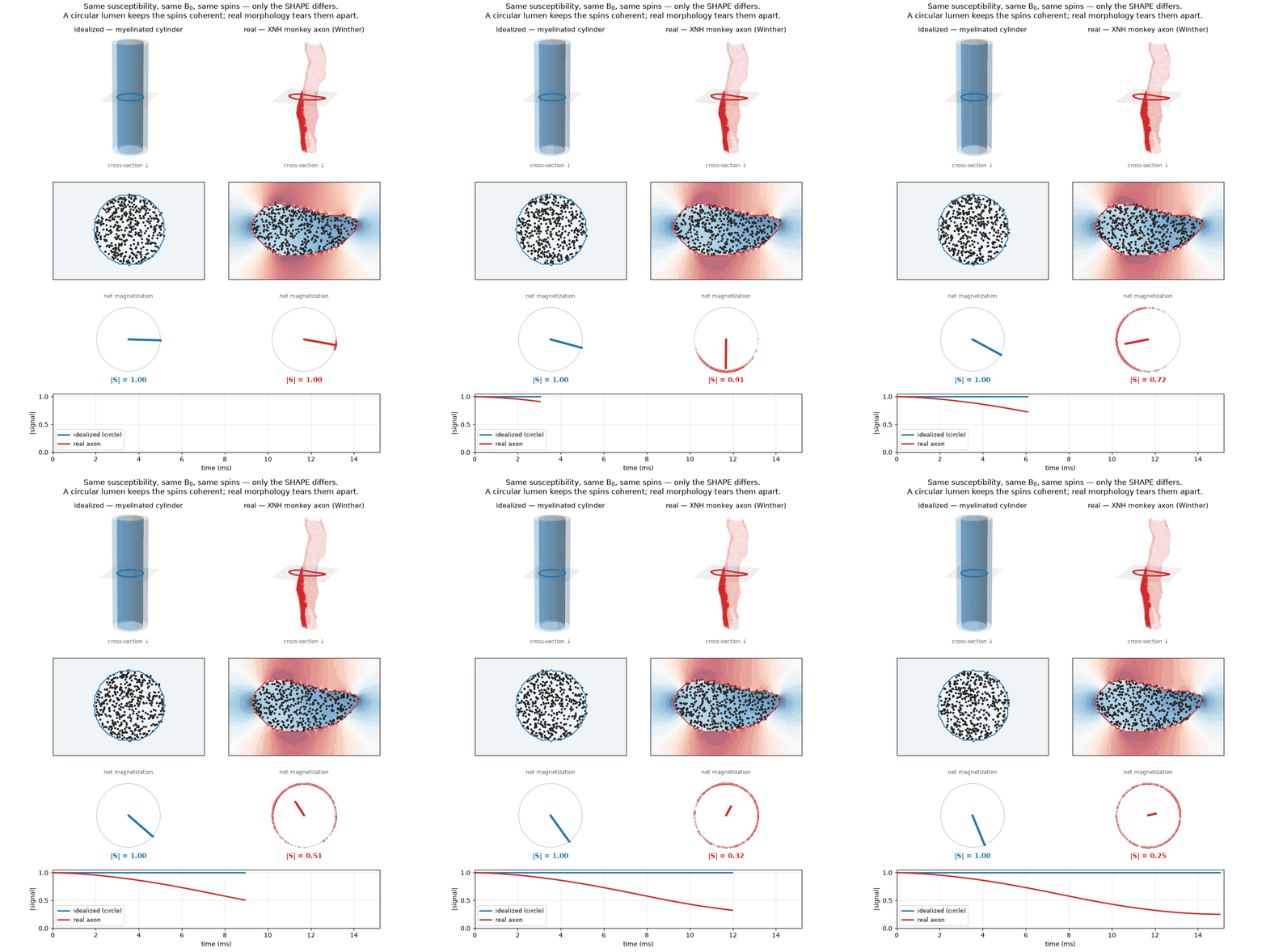
This is the whole story in one loop. The top row is each axon in 3-D — a generated myelinated cylinder and the real XNH monkey axon mesh (Winther's G6 segmentation), same orientation — with a cutting plane marking where the cross-section below is taken. In the cross-section the two lumens carry identical susceptibility, main field and spins. Inside the circle the internal field is uniform, so every spin precesses together and the net magnetization only rotates (|S| stays 1). Inside the real, non-circular lumen the field varies from point to point, the spins fan out on the phasor clock, and the signal collapses. The susceptibility-induced dephasing reads out the morphology — the Winther 2024 finding, live.
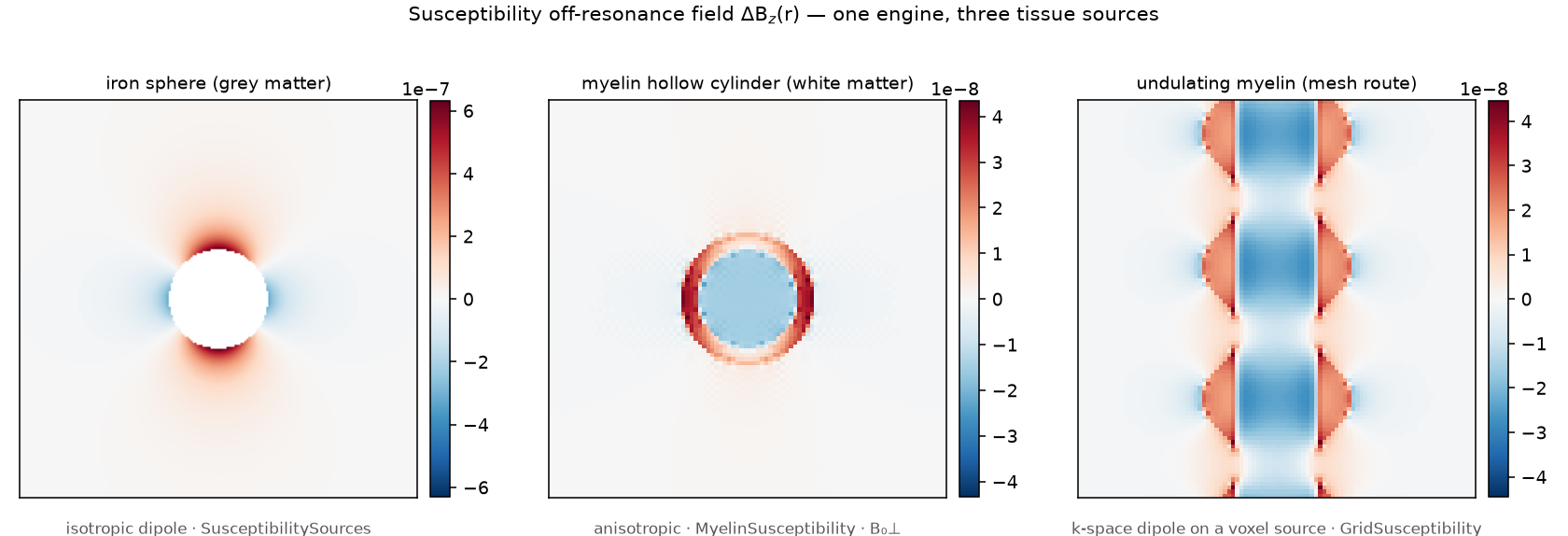
One engine, three sources
The field enters the walk as a per-step z-precession \(\gamma\,\Delta B_z(\mathbf r)\,dt\); \(\Delta B_z\) comes from whichever source describes the tissue:
SusceptibilitySources— isotropic magnetised spheres (grey-matter iron, vasculature): superposed uniformly-magnetised-sphere dipoles (Schenck 1996).MyelinSusceptibility— the anisotropic hollow-cylinder myelin field (Wharton & Bowtell 2012) in closed form; the intra-axonal offset is \(\tfrac12\,\Delta\chi_A B_0 \sin^2\!\theta\,\ln(1/g)\) — uniform inside the lumen and zero when \(B_0\parallel\) fibre.GridSusceptibility— an arbitrary distribution voxelised onto a grid and solved by the Lorentz-corrected k-space dipole model (Salomir 2003; Marques & Bowtell 2005). This is the route for real morphology — a segmented axon, an undulating sheath, any mesh.
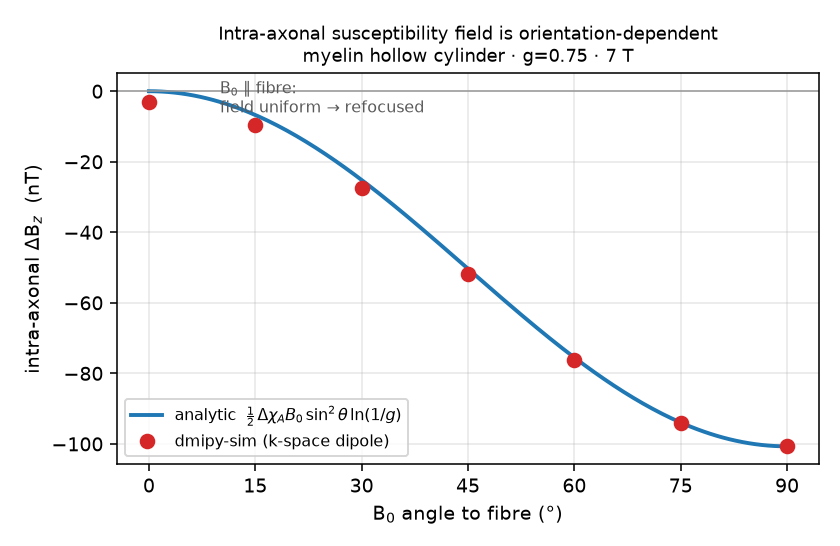
The intra-axonal field is orientation-dependent and vanishes when \(B_0\parallel\) fibre — where the internal field is uniform and the echo refocuses it completely — which is exactly why susceptibility reads out fibre orientation and morphology.
Because the field precesses the spin at its current position, it composes with the other effects in one pass: a substrate can carry diffusion, magnetization transfer and susceptibility together, and the sequence's own 180° pulse refocuses the static part of the field exactly as in a real spin echo — so a stimulated echo parks it alongside surface relaxivity, and the diffusion-driven residual is what survives.
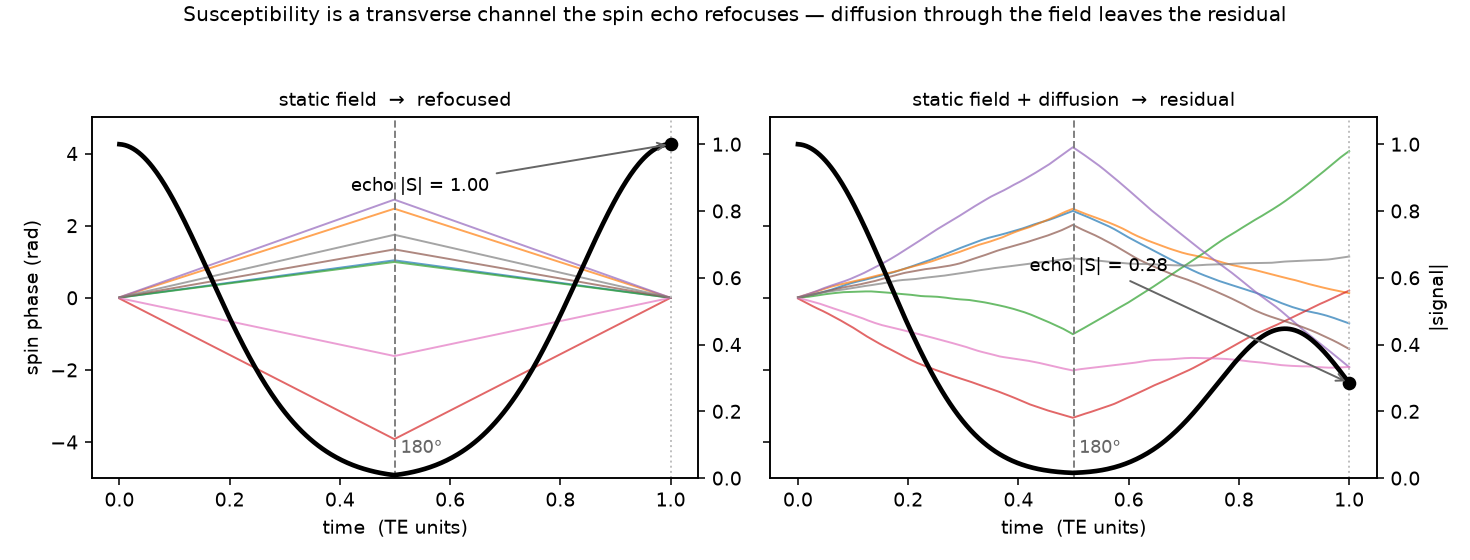
The 180° pulse refocuses the static part of the field exactly (the echo returns to full signal), so only the diffusion-driven part survives — the piece that actually carries microstructure.
from dmipy_sim import (run_bloch_sequence, spin_echo, Cylinder, MyelinSusceptibility)

susc = MyelinSusceptibility(centers=[[0, 0]], inner_radii=[2e-6], outer_radii=[3e-6],
                            L=20e-6, delta_chi_a=-0.1e-6, B0=7.0, theta=1.57)   # B0 ⊥ fibre
seq  = spin_echo(TE=40e-3, dt=1e-4)
S    = run_bloch_sequence(seq, n_walkers=50_000, diffusivity=0.6e-9,
                          geometry=Cylinder(radius=2e-6, orientation=(0, 0, 1)),
                          susceptibility=susc)
In the coherence-gating law
In the coherence-gating pair susceptibility is a purely transverse channel — the \(R_2'\) term of the apparent transverse rate,
acting only while the magnetization is transverse (\(\chi_\perp{=}1\)), with no counterpart in \(1/T_1^{\mathrm{app}}\): longitudinal storage pauses it over the mixing time.
Validation against the literature
The field solver is checked against exact analytics — isotropic sphere (zero internal field, Lorentz) and cylinder; the anisotropic hollow-cylinder intra field \(\tfrac12\,\chi_A B_0 \sin^2\!\theta\,\ln(1/g)\) — and against published Monte-Carlo findings on real segmented monkey axons (Winther et al. 2024).