Mesh substrates
Beyond the parametric geometries (cylinders, spheres, myelinated cylinders), dmipy-sim
runs arbitrary triangular surface meshes — the dense, irregular microstructures that
mesh-based substrate generators export as .ply. Loading such a file is a first-class,
one-line operation, and the walkers diffuse inside it with the same physics as the
analytic geometries: restricted diffusion, surface relaxivity, and membrane permeability.
from dmipy_sim import Mesh, simulate

# load a mesh, scaling normalised coordinates -> metres, as a 3-D-periodic pack
mesh = Mesh.from_ply("substrate.ply", scale=1e-5,
                     periodic=True, voxel_min=[-10e-6]*3, voxel_max=[10e-6]*3,
                     feature_radius=1.7e-6, permeability=2e-5)

mesh.quality_report()                        # per-effect resolution verdict
signal = simulate(n_walkers=50_000, diffusivity=2e-9, waveform=wf, geometry=mesh)
Loading needs the optional extra: pip install "dmipy-sim[mesh]".
What makes it work
- Spatial acceleration. A static uniform grid buckets every triangle; each step only
tests the triangles in the walker's 27-cell neighbourhood, so the per-step cost is
O(candidates)instead ofO(n_triangles)— a mesh with ~10⁶ triangles goes from intractable to seconds. - 3-D periodicity. With
periodic=True, triangles near the box faces are replicated as ghosts across to the opposite side; the box faces act as periodic wrap planes, so a cell clipped at the boundary is stitched to its partner. Geometry queries use the wrapped position while the reported position stays continuous, keeping the gradient phase correct. - Smooth reflection & leak-proof permeation. Reflections use an interpolated vertex
normal (faceting error
O(h²/R²)), and the Powles crossing is decided once at the first membrane hit, with a multi-bounce reflection for the remainder. - Placement in the bore.
orientation=(or a rotationR=) declares how the mesh sits relative to the main field (B0 = +z); it is applied as an acquisition rotation, so the validated walk itself is untouched.
Accuracy and resolution
A triangulated shape reproduces the analytic signal of the same shape to the Monte-Carlo
noise floor. Restricted diffusion and surface relaxivity reach it even for coarse meshes;
membrane permeability is more sensitive to the surface tessellation — its faceting
bias falls as O(h²), so a heavily-decimated mesh under-resolves permeability. Mesh
warns at construction, and quality_report() gives a per-effect verdict, when the edge
length is too large relative to the feature size (edge / feature ≳ 0.05).
Look inside — walkers in the substrate
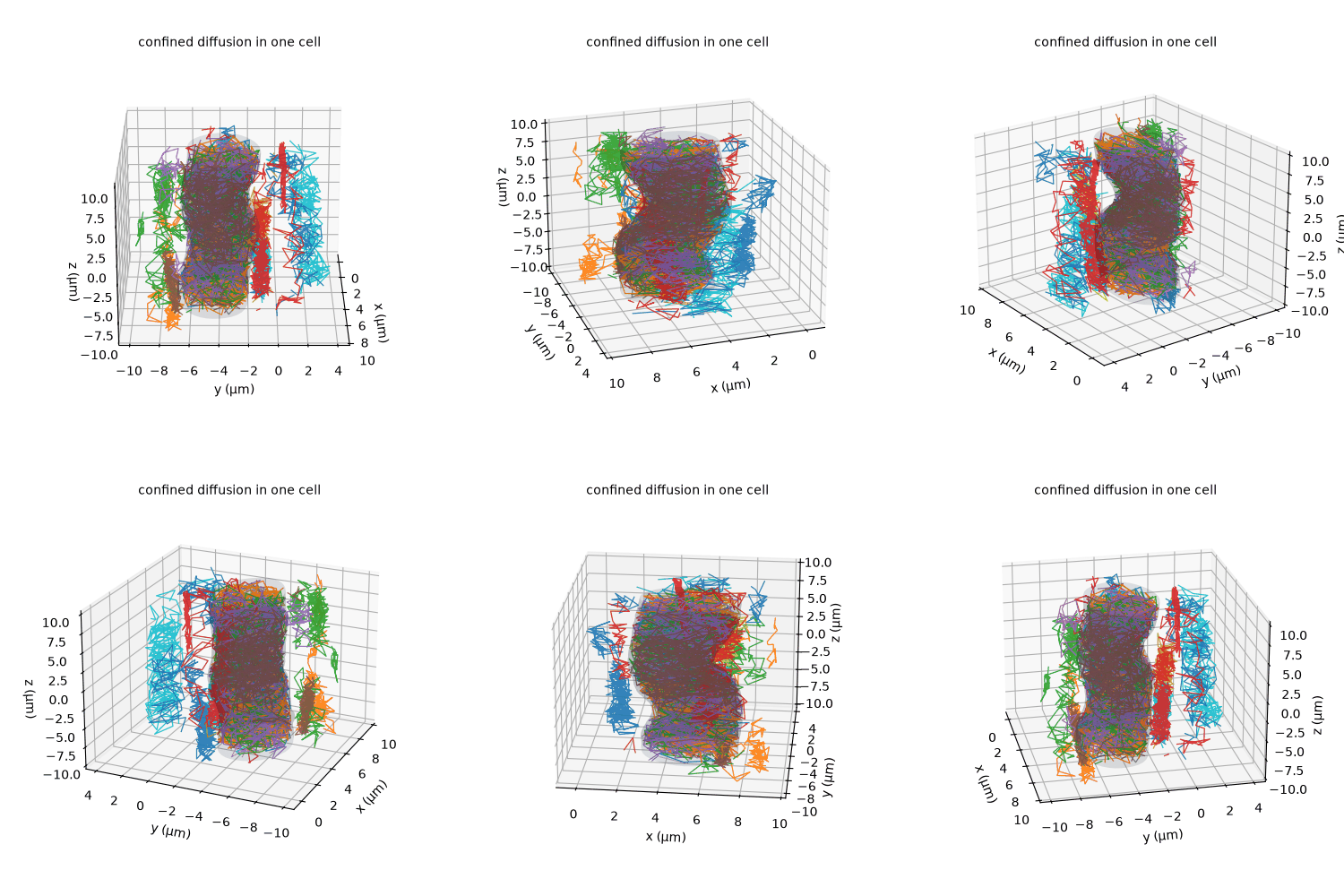
dmipy_sim.viz turns a loaded mesh into a picture. The honest view for a 3-D substrate is
a transparent cell with walker paths confined inside it (no plane slice, no
projection):
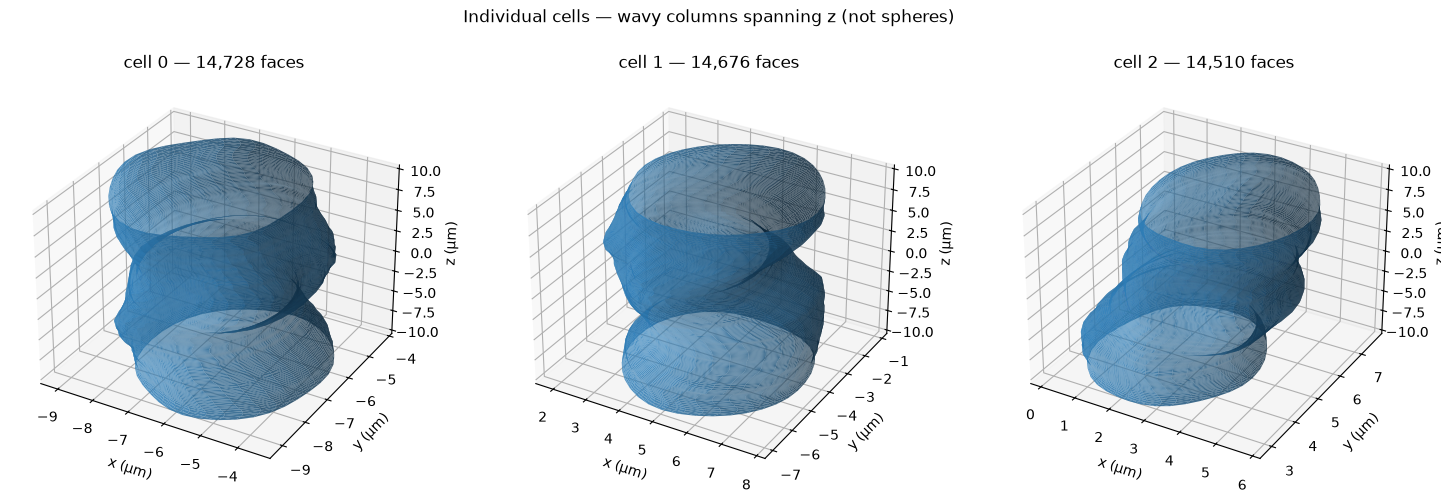
The cells in this example are wavy columns spanning the periodic axis — something a single flat slice reads as round blobs, but the 3-D view (and extracting one connected cell) makes obvious:
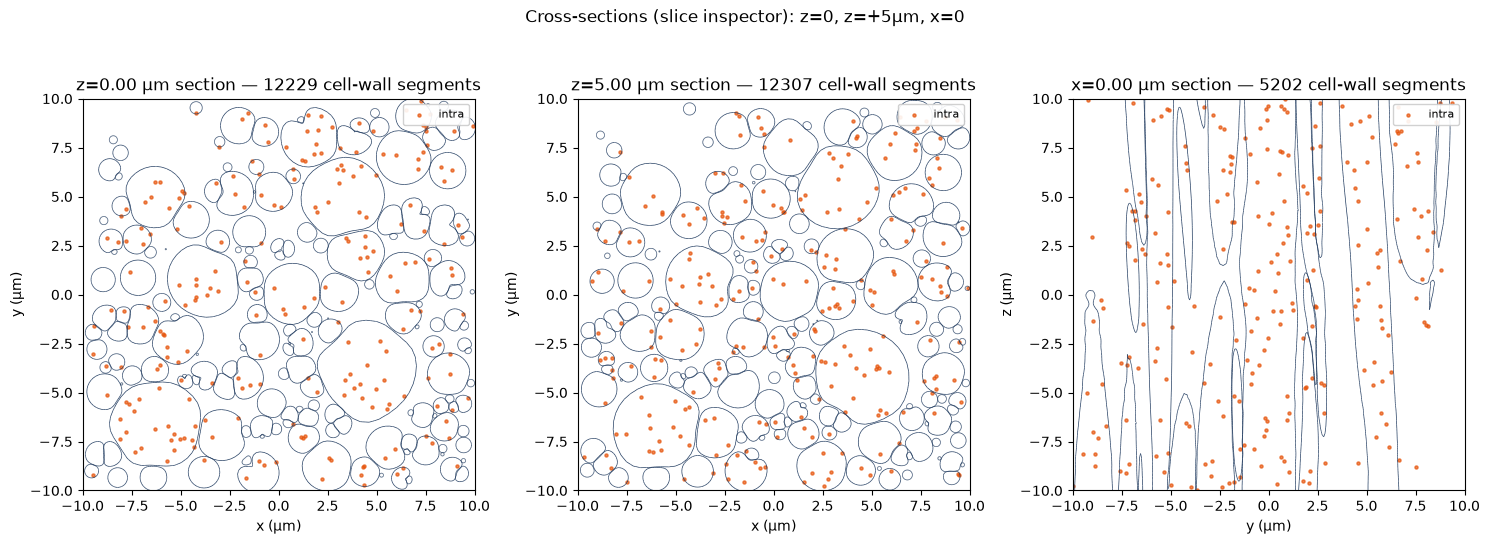
For substrates that are (approximately) invariant along an axis — or to inspect a deliberate pore or defect at a given plane — a cross-section draws every cell wall with walkers overlaid:
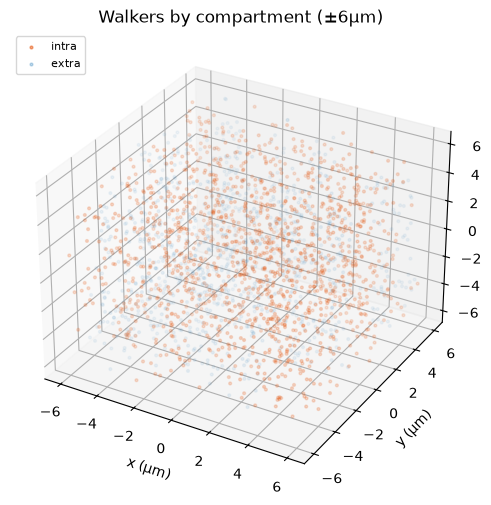
Walkers can be seeded inside or outside the cells; the intra/extra split matches the substrate's volume fraction:
Trajectories can be exported (return_positions='full') and, combined with per-timestep
compartment labels, filtered — for example to visualise only the walkers that crossed a
membrane.
from dmipy_sim import (Mesh, plot_mesh_3d, seed_in_cell, walk_paths,
                       plot_mesh_section, save_rotation)
from dmipy_sim.viz import _split_cells

cell  = _split_cells(mesh)[1]                       # an interior cell
paths = walk_paths(mesh, 16, 500, diffusivity=2e-9, dt=2e-4, r0=seed_in_cell(cell, 16))
ax = plot_mesh_3d(mesh, cells=(1,), paths=paths)    # transparent cell + confined paths
save_rotation(ax, "cell_spin.gif")                  # animated GIF for slides
The viz helpers (plot_mesh_3d, plot_mesh_section, plot_cell_surface,
plot_walkers_3d, walk_paths + plot_trajectories, save_rotation) live in
dmipy_sim.viz; a runnable walkthrough is the
mesh loading + visualisation notebook
(open in Colab).